
30. Overview
Bare metal Rust programs, such as those using the cortex-m-rt (v0.6.x) crate on
the Armv7E-M bare-metal (soft-float) or Armv7E-M bare-metal (hard-float) targets, may not necessarily
be memory safe in the presence of stack overflows.
The following program, which contains no unsafe code block, can run into undefined behavior if it reaches a stack overflow condition:
// static variables placed in the .bss / .data sections
static FLAG1: AtomicBool = AtomicBool::new(false); // .bss
static FLAG2: AtomicBool = AtomicBool::new(true);  // .data

fn main() {
    let _x = fib(100);
}

#[inline(never)]
fn fib(n: u32) -> u32 {
    // allocate and initialize 4 kilobytes of stack memory
    let _use_stack = [0xAA; 1024];

    if n < 2 {
        1
    } else {
        fib(n - 1) + fib(n - 2) // recursion
    }
}

#[interrupt]
fn interrupt_handler() {
    // does some operation with `FLAG1` and `FLAG2`
}
This is due to the default memory layout of ARM Cortex-M programs in RAM, shown below:
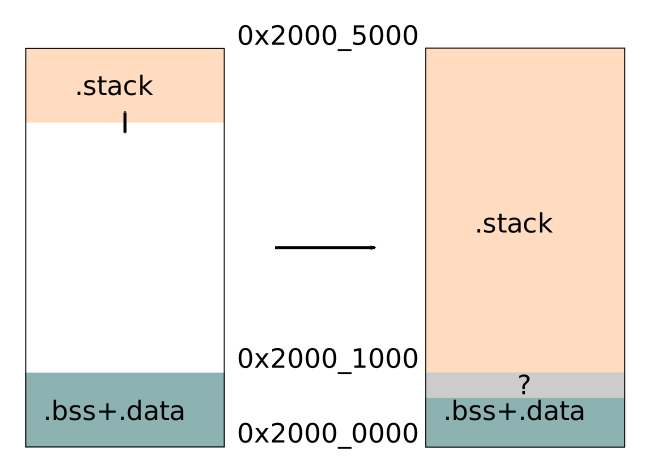
The default memory layout of ARM Cortex-M programs in RAM.
The function call stack, also known as the “stack”, grows downwards on function calls and when
local variables (e.g. let x) are created (these variables are also placed on the stack).
If the stack grows too large it collides with the .bss+.data region, which contains all the
program’s static variables. The collision results in the static variables being overwritten
with unrelated data. This can result in the program observing the static variables in an invalid
state: for example an AtomicBool may hold the value 3 – this is undefined behavior because
the Rust ABI expects this single-byte variable to be either 0 or 1.
One potential solution is to change the memory layout of the program and place the stack below the
.bss+.data region.
With this flipped memory layout (pictured below) the stack cannot collide with the static
variables. Instead it will collide with the boundary of the physical RAM memory region. In the ARM
Cortex-M architecture, trying to read or write past the boundaries of the RAM region produces a
“hardware exception”. The cortex-m-rt crate provides an API to handle this condition: a
HardFault exception handler can be defined; this “handler” (function) will be executed when the
invalid memory operation is attempted.
flip-link implements this stack overflow solution. Linking your program with flip-link
produces the flipped memory layout, which is memory safe in presence of stack overflows.
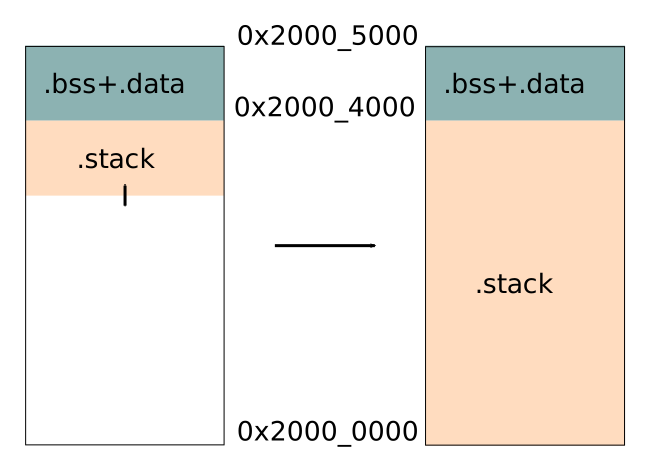
The memory layout of ARM Cortex-M programs in RAM after flip-link.